For importers, brands, and retailers, sourcing from overseas has become standard practice. To manage quality risks, many businesses rely on regular inspections to verify products before they ship to their destination markets. In this process, understanding how to effectively apply AQL (Acceptable Quality Level) is essential:
- AQL provides a standardized method to evaluate product quality
- AQL helps businesses balance cost and risk
- AQL allows for objective pass/fail decisions during inspections
In this guide, we’ll walk you through how to use AQL to manage and improve product quality—drawing on over 18 years of experience in the quality control industry. Let’s get started.
Or, you can click the links below to jump to each of these sections:
- What Is AQL (Acceptable Quality Level)?
- Where Is AQL Used? (Industries & Scenarios)
- Why Do Brands and Retailers Use AQL?
- How Does AQL Work? (Step-by-Step Guide)
- Recommended AQL for Consumer Product Industry
- What Happens If AQL Fails?
- Common Mistakes When Using AQL
- Best Practices for Importers Using AQL
- Work with a Reliable Third-Party Inspection Partner for AQL
What Is AQL (Acceptable Quality Level)?
AQL stands for Acceptable Quality Level, a widely used standard in quality inspections.
In the world of inspection, the expense is related to how many manday is required: the more items you inspect, the larger manday you will need. Surely the safest way is to check every item you manufacture red but it requires massive time, and it’s not friendly to your budget. That’s where AQL came in.
Instead of inspecting 100% of goods, AQL uses a sampling approach to determine whether a shipment meets quality requirements.
- It defines the maximum number of defects considered acceptable
- It is based on sampling, not full inspection
- It is part of the internationally recognized standard ANSI/ASQ Z1.4
Where Is AQL Used? (Industries & Scenarios)
AQL is used across a wide range of industries and inspection types.
Common industries:
- Apparel and textiles
- Consumer electronics
- Toys and juvenile products
- Cosmetics and packaging
- Home goods and furniture
Typical use cases:
- Pre-Shipment inspections (PSI)
- Final Random Inspection (FRI)
- Pre-Production Inspection (PPI)
- During Production Inspection (DUPRO or DPI)
AQL is especially valuable when:
- Products are manufactured overseas
- Full inspection is not practical
- Consistency across batches is critical
Why Do Brands and Retailers Use AQL?
AQL is popular because it provides a structured and cost-effective approach to quality control.
Key benefits:
Cost efficiency- Avoid expensive 100% inspections
- Reduces unnecessary labor
- Removes subjective judgment
- Creates clear pass/fail criteria
- Controls defect levels in shipments
- Helps prevent large-scale quality issues
- Sets clear expectations upfront
- Reduces disputes over quality
How Does AQL Work? (Step-by-Step Guide)
Using AQL involves a structured process.
Step 1: Choose your inspection type and inspection level
- Choose from General Inspection Levels (I, II, III) and Special Inspection Levels (I, II, III)
- You’ll most likely want to go with general as the special inspection type is reserved for particular types of product testing or to perform on a smaller portion of your order
- General Inspection Level II is the most commonly used
Step 2: Determine sample size letter based on your lot size
- Based on lot size and inspection level
- Find your sample size letter to determine the sample size
Step 3: Set AQL for your inspection
- Define the defect tolerance based on the sample size and selected inspection level
- Many brands and retailers have different tolerances on different defect types (Critical, Major, Minor) so likely you will set three AQLs for different types of quality defects.
- Critical: Safety or regulatory issues
- Major: Functionality or usability problems
- Minor: Cosmetic issues
Step 4: Conduct the inspection and compare results
- Count defects found
- Compare with acceptance numbers
- Decide pass or fail
Example:
- Your lot size: 1,000 units
- Your selected inspection level: General II
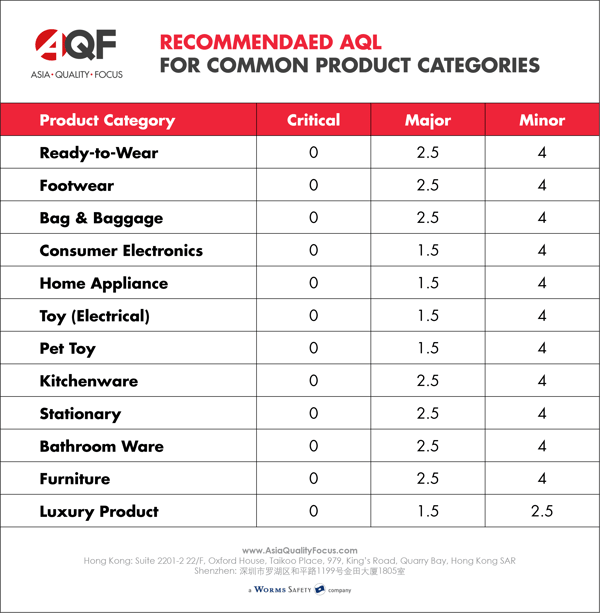
- Your selected AQL: 0 for critical defects, 2.5 for major defects, 4 for minor defects
- Sample size: 80 units
- Inspection finding: no critical defect found, 6 major defects found, 5 for minor defects
- Your AQL result: Fail
Recommended AQL for Consumer Product Industry
What Happens If AQL Fails?
An AQL failure means the number of defects exceeds the set acceptable limit. Normally, the fail AQL result will lead to a fail inspection result. However, a failed inspection doesn’t mean your produced goods are totally unacceptable. Here are what you need to do after receiving a fail result:
- Review the report carefully to understand what defects were found. You can also share this report with your supplier / manufacturer for their information.
- Develop a corrective action plan and share with your supplier
- Supplier to rework the defective items
- Conduct re-inspection to see if the defects are corrected and are ready to go
Common Mistakes When Using AQL
Many brands and retailers misuse AQL, leading to avoidable issues.
Frequent mistakes:
- Wrong inspection type and level may lead to erroneous results.
- Setting unrealistic AQL levels. Too strict standard can lead to frequent failures while being too lenient may lead to poor quality.
- Incorrect defect classification. Mislabeling critical, major, and minor defects
Avoiding these mistakes helps maximize the effectiveness of AQL.
Important clarification: AQL does not guarantee zero defects.
Best Practices for Importers Using AQL
- Share clear product specification files with your suppliers
- Plan inspections at different production stages to ensure consistent monitoring
- Define the right AQL for your products
- Work with trained, experienced third-party inspection companies to ensure no bias
- Review the inspection results carefully and apply corrective action if needed
- Adjust the inspection level and AQL based on the supplier history and risk level
- Maintain inspection records and use data to improve future orders
Remember, AQL works best when integrated into a broader quality control strategy.
Work with a Reliable Third-Party Inspection Partner
AQL isn’t easy to understand. For many brands and retailers, working with reliable third-party inspection companies plays a key role in AQL implementation and quality control.
At AQF, we are committed to providing global brands, importers, and retailers with independent and unbiased inspection results. With 18+ years of experience in the consumer product quality control industry, AQF has developed standardized inspection procedures for multiple product categories. Our knowledge of regional manufacturing practices and field experts in major manufacturing hubs enables us to support inspection requests and get back with clear and detailed reporting with a fast turnaround time.
A trusted partner can help you apply AQL correctly and reduce quality risks across your supply chain. Contact AQF today.
Related:
Explaining 3 General Inspection Levels for QC Sampling with AQL
A Guide to the 3 Types of Quality Defects for Defect Classification
How Importers Use the AQL Table for Product Inspection